Home

Welcome to the Center for Autonomy

The Center for Autonomy brings together several research groups that address fundamental challenges in developing autonomous systems through contributions in controls, machine learning, game theory, information theory, and formal methods. Its primary objective is to create a unified front in attracting the best researchers to UT Austin and empowering them to solve the pressing problems toward developing autonomous systems that can make a net positive impact.
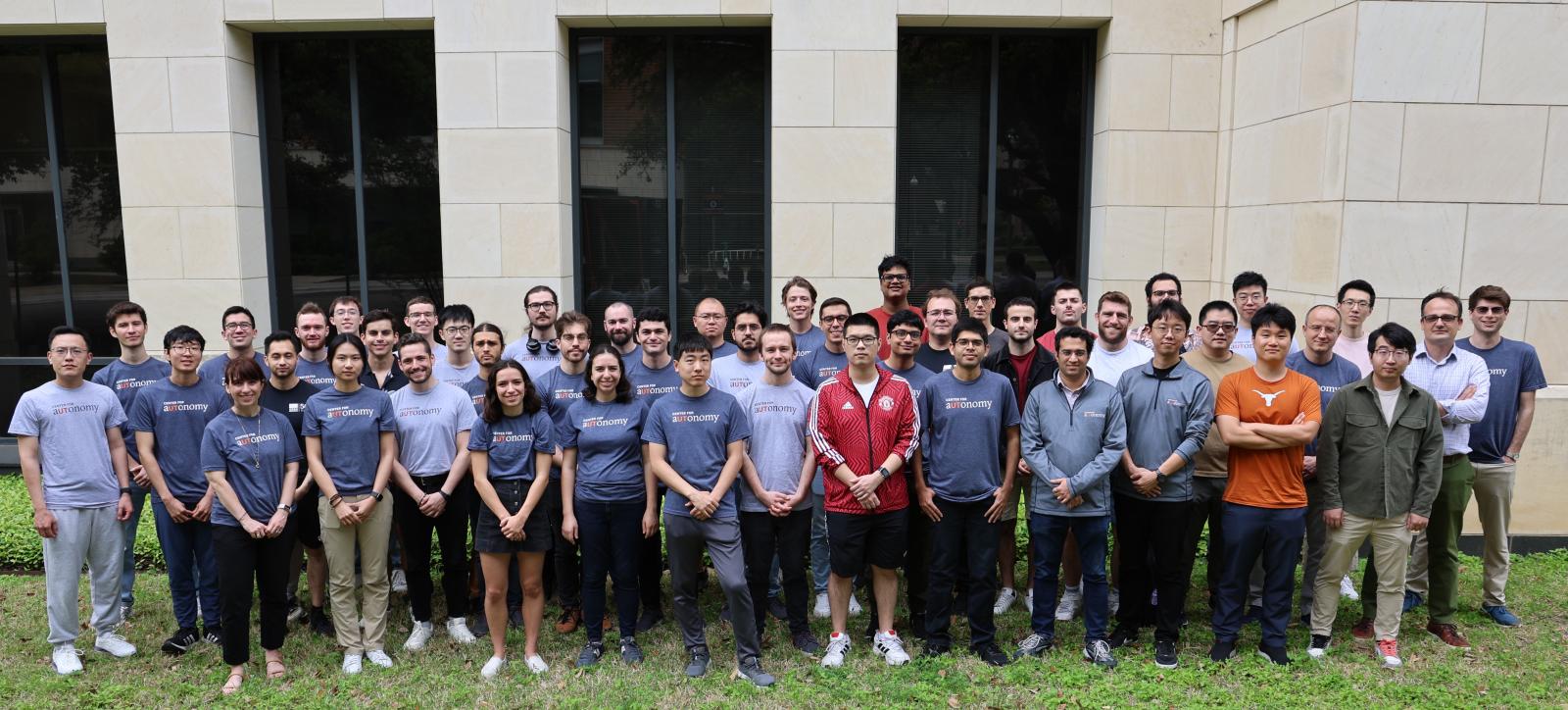
Photo of Center for Autonomy group members

Upcoming Events

Go2 and Husky Clearpath Robots
Event Status
Scheduled
Date and time: Monday June 1, 2026 - Monday August 10, 2026, All day
The Army Educational Outreach Program (AEOP) summer internship, “Verifiable Integration of Multi-Modal Pre-Trained Generative Models in Sequential Decision-Making for Autonomous Systems,” provides summer support for two qualified undergraduate students to work with faculty, mentors, and research staff from the Center of Autonomy during the summer months. Click for more info on this paid internship opportunity!

News

The interior of a Waymo car is pictured on Sept. 24, 2024.

Engineering Researchers Explore New Safety Systems for Autonomous Vehicles

March 6, 2026
Autonomous systems deployed in real-world environments must operate safely despite uncertainty, adaptation, and changing conditions. Researchers in the Center for Autonomy at The University of Texas at Austin are developing dynamic certification frameworks that continuously evaluate system behavior instead of relying solely on static pre-deployment testing. The goal is to provide more robust safety assurance for autonomous vehicles and other robotic systems as they are increasingly deployed outside controlled settings.
Self Driving stock photo

Rethinking Safety Certification for Autonomous Systems

Feb. 19, 2026
Ensuring the safety of autonomous systems requires certification methods that can keep pace with systems that learn, update, and operate in changing environments. Researchers at The University of Texas at Austin and collaborating institutions are developing new frameworks that move beyond traditional static certification approaches. The multi-university effort integrates expertise in controls, formal methods, machine learning, human factors, robotics, and systems engineering to study scalable methods for assuring safety in real-world autonomous systems.
Photo of John-Paul Clarke

Engineering Researchers Explore New Safety Systems for Autonomous Vehicles - Cloned

Feb. 10, 2026
John‑Paul Clarke, a professor of aerospace engineering at The University of Texas at Austin, was elected to the National Academy of Engineering. Clarke is recognized for pioneering aircraft arrival procedures that allow planes to glide during descent, reducing fuel use, emissions, and noise, and now used at major airports worldwide. His work in aircraft trajectory optimization and air traffic operations has helped improve the efficiency and environmental performance of modern aviation systems.

Outreach Events

DVISD Interns learning robotics

Center for Autonomy Strengthens Outreach Initiatives

Photo of Summer 2025 Interns and Mentors

Robotics, AI and Programming: The Center for Autonomy Summer Research Internship Programs

Andres navigating the vehicle. Credit: Joanne Foote

Local High School Students Gain Hands-On Experience Through Robotics Tour

Student looking through virtual headset in TACC lab

Learning Together: Del Valle Juniors and Seniors Visit UT

REACT participants at the Center for Autonomy Lab

Center for Autonomy Inspires Undergraduates Through Research Experience Program